How Coastal Wind Lifts Roof Sheets and Loosens Fixings
Living near the coast brings light, outlook and sea air, but it also puts more pressure on a roof than many owners expect. Across the 'Northern Beaches', strong gusts do not need cyclone strength to start shifting metal roof sheets, stressing fixings and opening tiny paths for water. On exposed streets in Newport, Palm Beach and other headland or ridgeline locations, that process can happen faster.
A lot of people think wind resistance is mainly about the roof sheet profile. The profile matters, but it is only part of the picture. A roof behaves as a system. Sheets, screws, washers, battens, flashings, cappings and laps all share the load. If one part starts to weaken, the rest of the roof has to work harder.
Why coastal wind affects roofing on the Northern Beaches
Wind does not simply blow against a roof. As it moves over the surface, it can create suction that pulls upward on sheet edges, ridges and corners. Those perimeter zones usually see the highest uplift forces. If the roof also has openings that let air pressure build inside, the upward force can increase again.
That is why coastal roofing problems often begin at the edges. A sheet may lift only slightly at first. The movement can be hard to see from the ground, yet that repeated flexing places stress on every fixing nearby. Over time, screws can loosen, washers can compress or split, and flashing seals can start to fail.
Wind-driven rain adds another layer of risk. Once a lap or edge opens even a little, water does not always fall straight down into the house. It can track along the underside of sheeting, around fixings or into roof cavities before a ceiling stain appears. By then, the entry point may be well away from the visible damage.
For homes in the 'Northern Beaches', exposure matters. A sheltered block with nearby tree cover faces different conditions from a property on an open slope or near the shoreline. Newport and Palm Beach often remind owners that ocean-facing wind is persistent, salty and difficult on small roofing components.
Australian metal roofing fixings and wind uplift requirements
Australian roofing practice treats wind uplift as a fastening issue as much as a cladding issue. That approach is backed by testing. James Cook University’s Cyclone Testing Station carries out testing on roofing screws and full-scale roof and wall cladding systems under severe wind loads, including airbox testing that simulates wind pressure on roofing elements. That tells us something important: the real question is not just whether a sheet is strong enough, but whether the whole fixing arrangement stays secure when pressure changes rapidly.
The National Construction Code also reflects this system-based view. Metal sheet roofing must be fixed either through the roofing or by concealed fasteners, and fixing requirements vary by profile and span. The code also distinguishes between end-span and internal-span fixing patterns, because roof edges and ends are exposed to different uplift conditions. It also states that, wherever possible, the side lap should be laid away from prevailing weather.
That last point is easy to overlook. Side lap direction may seem minor on a calm day, yet in a coastal squall it can affect how easily wind-driven rain is pushed beneath the sheeting.
Roof area | What coastal wind tends to do | What often follows | What a roofer checks |
|---|---|---|---|
Sheet edges and corners | Creates high uplift suction | Lifting sheets, rattling, water entry | Fixing spacing, sheet alignment, edge restraint |
Side laps | Repeated movement and pressure on overlaps | Open laps, capillary water entry | Lap direction, stitch fixings, seal condition |
Ridge capping | Turbulence across the roof peak | Loose capping, failed seals | Screw security, capping straightness, sealant wear |
Flashings around penetrations | Concentrates pressure around junctions | Leaks near skylights, vents, walls | Flashing lift, seal breaks, corrosion |
Gutter and fascia junctions | Pushes water back and stresses edges | Eave leaks, overflow, fascia damage | Apron flashing, gutter brackets, debris build-up |
Common Northern Beaches roof weak points: screws, laps and flashings
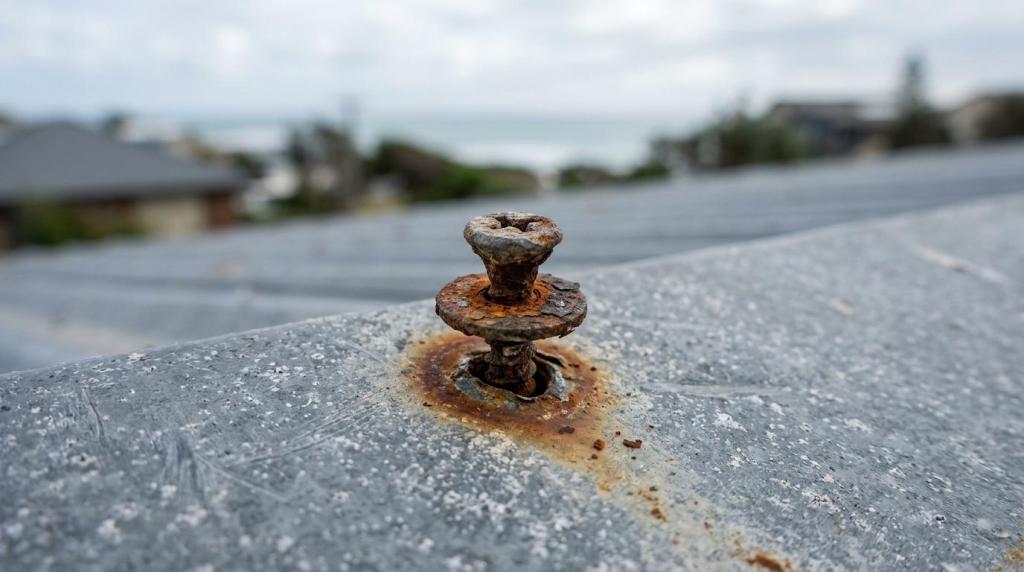
Local roof maintenance across the 'Northern Beaches' often comes back to the same trouble spots. Inspections regularly focus on rust around screws, loosened fixings and flashing or failed flashing. Cloud9 Roofing & Guttering also notes that local inspections commonly check for rust around screws, lifting sheets and weakening attachment points, along with loose ridge capping and failed flashing.
That pattern makes sense. The sheets themselves can remain serviceable for years while the smaller components begin to age first. Salt air, strong sun, gusting wind and wind-driven rain are hard on washers, sealants and exposed fixings. Once those components start slipping, the roof can still look mostly intact from the street.
The parts below are often where early movement shows up:
Sheet edges
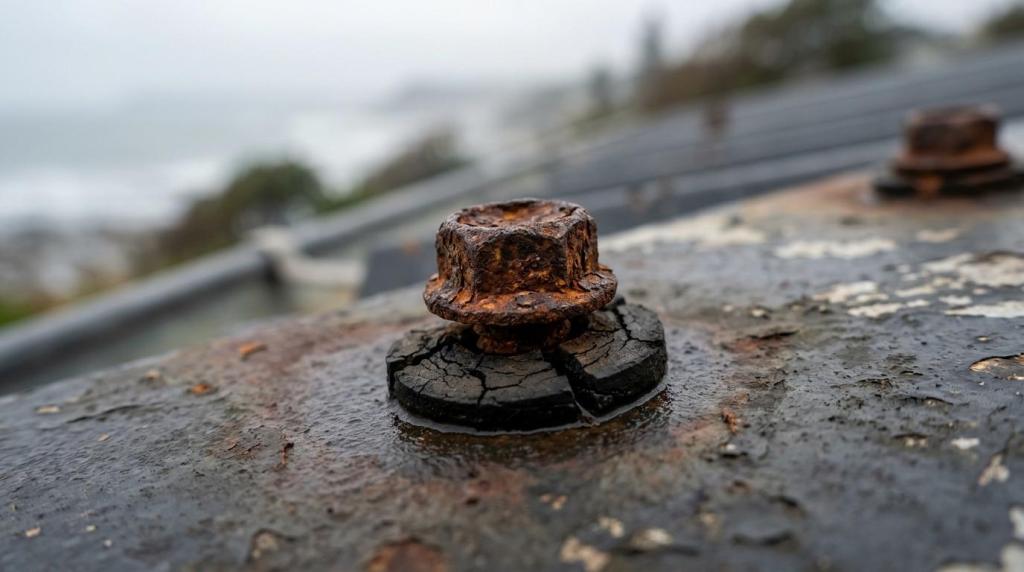
Rust around screws
Screw washers: UV and salt can harden, shrink or crack them
Ridge capping: repeated gusts can loosen fixings and break seals
Flashing junctions: a small opening can let water travel sideways before it becomes visible inside
How roof sheet movement loosens fixings over time
Failure is often progressive, not dramatic.
A metal roof may move a little during strong winds and a little again during heating and cooling cycles. That repeated motion is normal to a point, but it becomes a problem when fixings are poorly selected, incorrectly installed or already affected by corrosion. The screw hole can start to wear, the washer may lose compression, and the sheet can gain enough freedom to lift again in the next gust. Each cycle adds a bit more stress.
This is one reason small defects should not be brushed off. A single loose fixing can transfer more load to surrounding fasteners. If a sheet edge starts fluttering, the nearby screws are no longer sharing the job evenly. In a storm, uneven load paths are rarely kind to roofing systems.
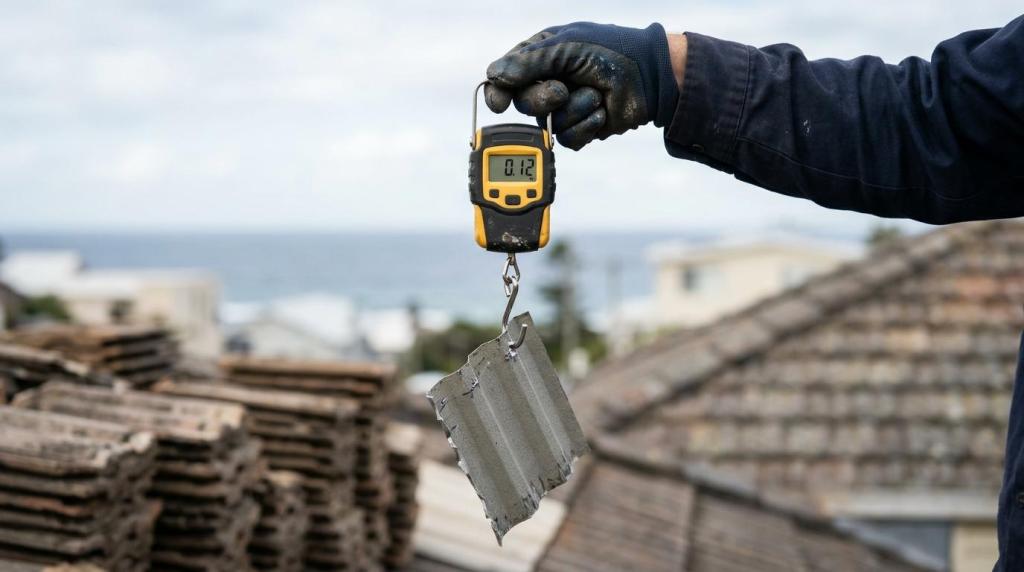
Lighter metal roofing is often a smart choice for homes because it places far less structural load on the building than heavy tile roofing. A metal roof can be around 5 kg per square metre, compared with roughly 60 kg per square metre for tiles. That lower weight is a major structural advantage. It does not mean wind resistance is less important. If anything, it makes correct fastening and edge restraint even more central to performance.
Owners sometimes notice subtle clues before a leak becomes obvious:
Ticking or rattling in strong wind
Slight flutter at a sheet edge
Fine staining around fastener lines
Water marks after squalls: the water entry point may sit upslope from the stain
Uneven sheet lines: movement at laps or fixings can make panels look out of plane
Coastal fastener performance for metal roofing Northern Beaches homes
On many coastal roofs, screws fail before the sheets do. That is a useful way to think about maintenance. When a roof survives wind, it is often because the fasteners keep doing their job under repeated uplift, salt exposure and moisture cycling.
Cloud9 Roofing & Guttering recommends corrosion-resistant screws rated Class 4 or Class 5 for salt exposure when older fixings need replacement. That recommendation reflects what coastal conditions do to metal components. Even when the roof sheeting is still in reasonable condition, exposed screws can rust, washers can age, and the seal beneath the head can lose resilience.
Installation quality matters just as much as the screw rating. An overtightened screw can crush the washer and shorten its life. An undertightened screw may leave a path for water and allow more movement under wind load. Mixed metals can also create avoidable corrosion problems if components are not chosen for compatibility.
Good fixing practice usually includes the following:
Correct screw selection: matched to the sheet profile and the substrate beneath
Coastal corrosion rating: suitable for salt-laden air in exposed suburbs
Code-compliant spacing: based on the roof profile, span and edge conditions
Washer condition: firm, properly seated and not split or distorted
Timely replacement: rusted or loose fasteners changed before holes enlarge or laps shift
Roof inspection priorities for roofing Northern Beaches properties
A roof inspection after major wind and rain is sensible, especially for homes close to the water or on elevated sites. Not every problem creates instant internal damage. Wind loading can create leak paths that are hidden from ground level, and some of the most important warning signs sit around attachment points rather than across the main field of the roof.
For properties in Newport, Palm Beach and other exposed parts of the 'Northern Beaches', inspections are often less about dramatic damage and more about early movement. A roofer may be looking for rust around screws, slight lifting at edges, loose ridge capping, failed flashing and signs that wind-driven rain has been getting past laps or penetrations. These checks matter just as much after a series of smaller coastal fronts as they do after one severe storm.
Leaf build-up is worth mentioning too. It does not cause wind uplift by itself, yet it traps moisture, adds corrosion pressure around fixings and can contribute to gutter overflow during driving rain. When water backs up at eaves and junctions, roof edge details are put under extra strain.
If a metal roof has started rattling, showing new water marks or revealing visible screw corrosion, waiting through another storm season is not a strong plan. The weak points on coastal roofs are often the fixings and edges, not the broad sheet areas people notice first. With the right fastening pattern, corrosion-resistant components and regular inspection, metal roofing on the 'Northern Beaches' can perform extremely well even under demanding coastal weather.